SIGNAL
The line item nobody renegotiates up
For most of its history, application managed services has been sold on a promise nobody says out loud: keep it running, keep it cheap, keep it quiet. AMS won contracts on discipline, not intelligence — tighter SLAs, cheaper headcount, fewer surprises. It was insurance, not investment, and clients priced it accordingly.
That's the part of the industry I think is about to be renegotiated. Not because clients suddenly value uptime more, but because the tools underneath AMS have changed enough that the work itself changed. When telemetry lives in a queryable platform and a model can read an incident before a human opens the ticket, “keep the lights on” stops being a cost center you manage down and starts being a capability you can point to.
CONTEXT
What the old model actually cost
Traditional AMS runs on tribal knowledge. Logs live in five different systems, dashboards are built for the last incident rather than the next one, and a Sev1 at 3 a.m. depends on whichever engineer happens to remember where the relevant table lives. Alert fatigue is not a side effect of this model — it's the default output of it. Escalation paths exist because no single view of the system exists.
None of this is a staffing problem. It's an information architecture problem, and for a long time there was no economical way to fix it: telemetry volumes were too large to query cheaply, and the people who understood the data were the same people who were supposed to be responding to it.
STACK
Azure Data Explorer, and why KQL changes the math
The first real shift is boring, in the way that good infrastructure usually is: centralize the telemetry, and give people a language fast enough to actually interrogate it. Azure Data Explorer is built for exactly this — billions of log, metric, and trace rows, queried in seconds rather than minutes, with KQL doing the work that used to require a bespoke script and a coffee break.
What that unlocks isn't just faster dashboards. It's pattern detection that used to be impossible on a ticket-by-ticket basis — the same latency spike that preceded the last four Sev2s, surfaced automatically instead of remembered by whoever was on call that week.
KQL — incident_ops.kqlAzure Data Explorer
IncidentEvents
| where TimeGenerated > ago(90d)
| where Severity in ("Sev1", "Sev2")
| summarize AvgResolutionMinutes = avg(ResolutionMinutes),
            Incidents = count()
          by bin(TimeGenerated, 7d)
| order by TimeGenerated asc
| render timechart
Nothing here is exotic. What matters is that a query like this now returns in the time it takes to read it, over a platform every engineer on the account can already query — not a report someone builds once a quarter.
AUTOMATION
Copilot doesn't replace the responder — it changes who responds first
Layered on top of that data platform, Copilot-driven automation does the part engineers least want to do at 3 a.m.: read the noise, correlate it against history, and draft a first hypothesis in plain language before a human is even paged. A natural-language query stands in for the KQL one when speed matters more than precision. A draft runbook shows up attached to the ticket instead of living in someone's head.
The important design choice is where the human stays in the loop. Remediation still needs a person to approve it. But triage, correlation, and root-cause drafting — the work that used to consume the first twenty minutes of every incident — increasingly happens before anyone is woken up. The senior engineer's job shifts from first responder to reviewer: tuning the model's judgment rather than being the model.
The scarce skill in AMS is no longer “knows where the logs are.” It's “knows when to override the model.”
INITIATIVE
What this looked like inside the ACE Support initiative
The clearest version of this shift I've watched play out has been inside Microsoft's ACE Support initiative, where AMS operations were rebuilt around this same combination — telemetry consolidated into Azure Data Explorer, KQL as the shared query layer across the team, and Copilot-driven automation sitting on top of both. It wasn't a rip-and-replace of the support model; it was the existing team, given a platform that let their judgment scale past the size of the queue.
The result wasn't fewer incidents. Systems still fail in the same ways they always have. What changed was how quickly the pattern behind a failure got surfaced, and how much of the early diagnostic work happened before a person had to sit down and do it by hand.
RESULTS
What moved
Two numbers made the case better than any architecture diagram did.
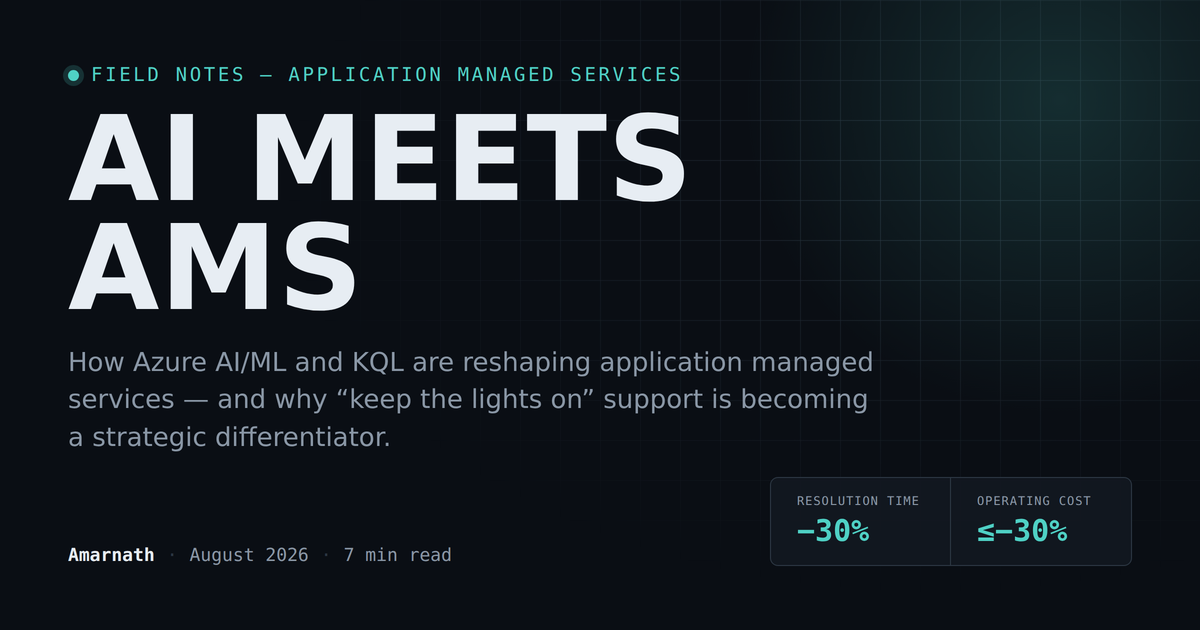
−30%
Incident resolution time, driven by automated correlation across telemetry instead of manual log-hopping.
≤−30%
Operating cost, as automation absorbed the triage and diagnostic hours that used to sit on every ticket.
Reactive → proactive
The more durable change: engineering time shifted from firefighting individual tickets to tuning the models and queries that catch the next one earlier.
ARGUMENT
From cost center to differentiator
Here's the strategic version of the same story. When resolution is faster and the cost to deliver it is lower, AMS stops being the line a client's procurement team negotiates down every renewal cycle. It becomes the reason they renew at all — a capability a competitor without the same data platform can quote a lower headline rate for, but can't actually match on outcome.
That's a moat, and it's a specific kind of moat: not proprietary technology, but the discipline of centralizing telemetry and building the query and automation layer on top of it before the AI gets credit for the result. Any provider can buy Copilot. Fewer have spent the unglamorous months making sure it has something worth reading.
OUTLOOK
The platform comes before the intelligence
This is still early. The pattern I'd expect over the next few years is AMS providers splitting into two groups — those who treat the data platform as the actual product and the AI layer as a feature of it, and those who bolt a copilot onto the same fragmented logging they've always had and wonder why the numbers don't move.
If there's one thing worth taking from this, it's that order of operations. Copilot is only as good as the telemetry underneath it. Get the platform right first, and “keep the lights on” starts paying for itself.