
- Home
- Industries
- Nuts & Peanut Butter
Digital Transformation for Nut and Peanut Butter Manufacturers
Nut processors balance crop variability, allergen discipline and private-label demand. Routeget connects sourcing, roasting, grinding and packing so quality and cost are controlled by lot.
30+
clients served
$15M+
Savings Delivered
15+ yrs
Serving the Sector
20+
Projects Delivered
Nut and Peanut Butter: where the market stands today
A fact base for planning. All figures below are third-party research estimates, not Routeget data, and they differ by how each firm defines the market.
Plant-protein and clean-label driven
Demand rises with fitness, plant-based protein and clean-label trends. Creamy styles hold most volume, while natural, organic and no-added-sugar variants grow fastest.
About US$4 billion to US$8.5 billion
The nut butters category is estimated at about US$3.7-3.95 billion (Market Research Future, Spherical Insights). Peanut butter alone is estimated at about US$7.4-8.5 billion in other reports, reflecting different scope.
About 4.5% to 6.9% CAGR
Nut butters are forecast to reach about US$6.0-6.16 billion by 2035 (about 4.5% CAGR), while peanut butter reports cite 5.8% to 6.9% CAGR. Asia-Pacific is the fastest-growing region.
Food safety and private-label margin
Retailers demand strict allergen and mycotoxin controls, and private-label contracts squeeze margin. Lot-level cost and quality data support both.
Sources: Market Research Future (nut butters); Spherical Insights; Custom Market Insights and Marketsandata (peanut butter); Market Data Forecast and Business Research Insights (segments). Estimates retrieved October 2026 and subject to each publisher’s definitions; verify against the publisher before citing externally.
End-to-end digital transformation
Strategy, platform selection, integration and data work delivered as one programme.
Food-industry data models
Lot, recipe, yield and co-product structures designed for process manufacturing.
Traceability by design
Forward and backward lot genealogy built into inventory and quality workflows.
Plant-floor integration
Connections between production lines, scales, quality systems and the warehouse.
Four pressures that shape nuts & peanut butter operations
These are the recurring problems we see when shelling, roasting, grinding and packing operations run on disconnected systems.
Allergen cross-contact
Nuts are a major allergen. Shared lines, rework and manual cleaning records raise risk and audit exposure.
Mycotoxin and quality testing
Incoming lots need testing and holds before use. Results scattered across email and paper slow release.
Crop-driven cost swings
Purchase prices and quality vary by crop year. Fixed retail contracts expose margin when sourcing is not tracked against sales.
Private-label complexity
Many labels, specifications and pack sizes increase planning effort and error risk.
Capabilities built for shelling, roasting, grinding and packing operations
Pick the area closest to your priority. Each can be delivered on its own or as part of a wider programme.
Buy, receive and test nuts with quality results attached to each lot.
- Supplier and origin records with approval status
- Testing and hold-and-release at receipt
- Contract and price tracking by crop year
- Storage and fumigation records
Make each batch a costed, traceable record.
- Roast profile and batch parameter capture
- Recipe control for sweeteners, oils and stabilisers
- Yield and loss tracking by line
- Pack and label control by customer
Prove that controls were followed.
- Allergen matrices and line clearance checks
- Inspection plans and metal-detection records
- Lot genealogy from farm to customer
- Customer audit and specification files
Run branded and private-label business on accurate cost.
- Customer-specific specifications and labels
- Margin by label, pack size and customer
- Promotion and rebate management
- Demand planning against crop inventory
Two scenarios where connected data changes the day-to-day
These are illustrative scenarios that describe the business objective. They are not customer case studies.
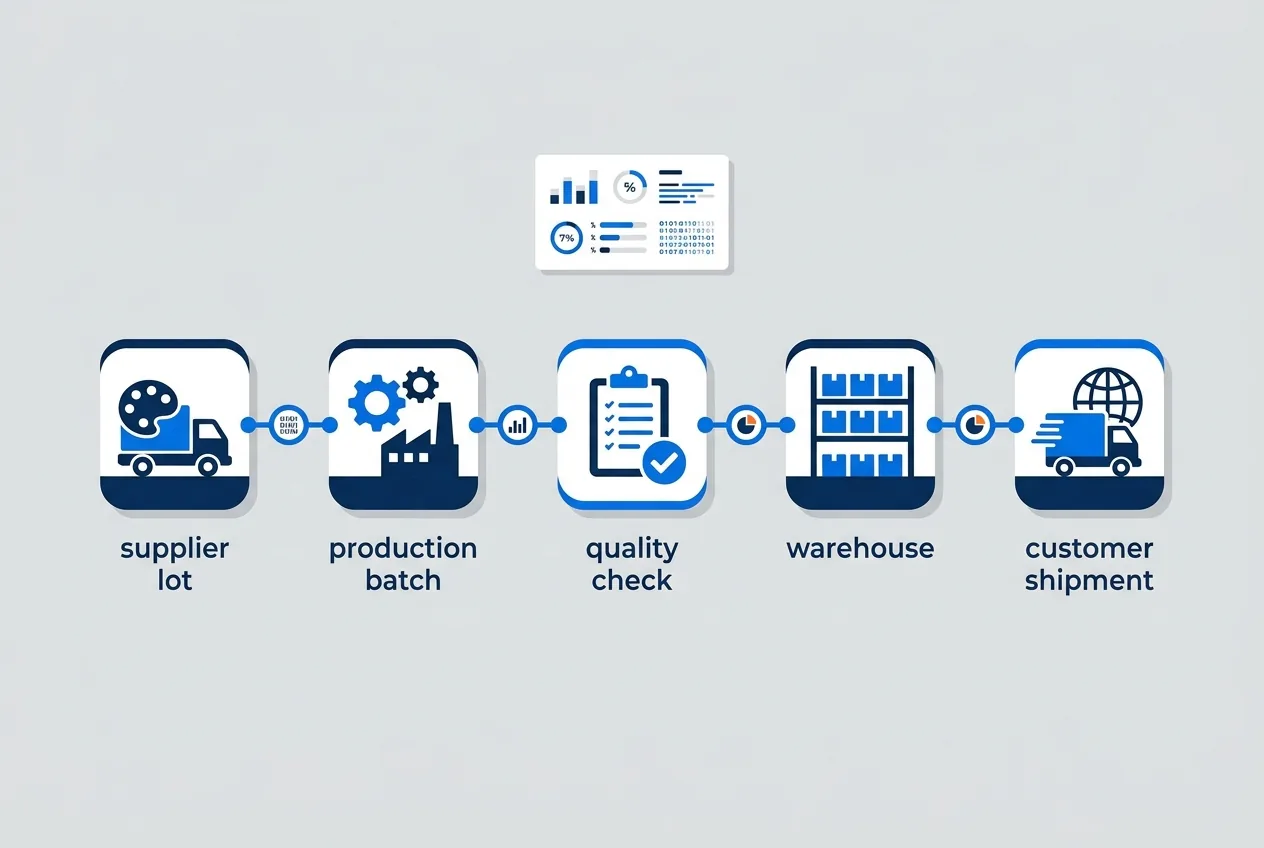
Release by lot after testing
Incoming lots are blocked until test results are recorded. The system releases only compliant stock to production and records who approved what and when.
Business objective: protect customers and speed release without manual chasing.
Private-label margin visibility
Cost per jar rolls up from nuts, packaging and labour. Commercial teams see margin per label and customer and renegotiate based on actual cost.
Business objective: make informed price and contract decisions.
How we approach delivery and evidence outcomes
We do not publish unverified customer figures on industry pages. This is how we make outcomes measurable in an engagement.
Baseline first
We agree the starting measures with you before design, such as aflatoxin-related rejects, roast yield and changeover time.
Delivery in stages
Releases are phased by site and process, so each stage is tested against real operations before the next.
Measured against your targets
Dashboards report the baseline measures from go-live, so benefit is judged on your data.
Examples of Routeget engagements can be discussed in a discovery call, subject to client approval for each reference.
Why Routeget for nuts & peanut butter
We bring a delivery approach built around the realities of crop-driven supply, allergen separation and a mix of branded and private-label business.
Allergen and lot discipline
We build allergen separation, aflatoxin testing and lot genealogy into daily workflows rather than treating them as end-of-line checks.
Integrated, not stitched together
Sourcing, roasting and grinding lines, quality, warehouse and finance share one data model, so operational and financial records reconcile.
Phased, low-disruption rollout
We plan releases around harvest cycles and retailer promotion calendars to protect service levels.
Data you can act on
Analytics are designed with your operations team, so measures reflect how your plants actually run.
Related reading from the Routeget team
Perspectives on the supply chain, data and integration topics behind this industry.
Why Automating our Supply Chain is Crucial to your Business Success
Why supply chain automation matters for service levels, cost and resilience.
The Evolving Landscape of Data Modernization Engineering
Trends in data modernization engineering and how they affect enterprise platforms.
AI attracts a new generation while assisting Argentine small producers and winemakers in competing
How AI is helping small producers compete in demanding markets.
Explore adjacent industry practices
Plan your nuts & peanut butter digital foundation with Routeget
Book a 30-minute discovery to walk through your sourcing, roasting and packing operations and your priorities with a Routeget industry specialist.
Your details are used only to respond to this enquiry. See our Privacy Policy.
Nuts & Peanut Butter: questions buyers ask us
How do you engage with a nuts & peanut butter business?
We usually start with a short discovery and a process review of one roasting and grinding line with its packing area. From there we propose a phased scope, which can be fixed-scope for defined releases or a time-and-materials team for ongoing improvement.
How do you support allergen control on shared lines?
We configure allergen matrices, line clearance checklists and records, so a changeover cannot be released until required steps are complete. Your food safety plan remains the authority.
Can you integrate testing results from external laboratories?
Yes. Results can be captured manually or through file or interface exchange, depending on what the laboratory offers, and linked to the lot.
Who owns the data and the configuration?
You do. The solution runs in your own environment, and configuration, data models and reports are documented and handed over so your team can maintain them.
How do you approach pricing and timelines?
Pricing and timing follow scope, including the number of lines, nut types and private-label customers. We share an estimate after discovery, with assumptions and exclusions stated, and we confirm timelines only after reviewing your landscape.