
- Home
- Industries
- Sauces & Dressing
Digital Transformation for Sauce and Dressing Manufacturers
Sauces and dressings combine many ingredients, recipes and pack formats for retail and foodservice. Routeget connects formulation, batching, quality and distribution to protect margin and consistency.
30+
clients served
$15M+
Savings Delivered
15+ yrs
Serving the Sector
20+
Projects Delivered
Sauces and Dressings: where the market stands today
A fact base for planning. All figures below are third-party research estimates, not Routeget data, and they differ by how each firm defines the market.
Global flavours and convenience
Consumers favour authentic international flavours, ready-to-use sauces and marinades, and clean-label or plant-based options. North America is large, and Asia-Pacific is among the fastest growing.
About US$155-203 billion (2024)
Market Research Future estimates about US$154.8 billion for 2024, while Strategic Market Research estimates about US$203.4 billion. Most reports centre between US$170 billion and US$190 billion.
4.8% to 6.1% CAGR
Most reports forecast roughly 4.8% to 6.1% CAGR, with the market reaching about US$250 billion to US$340 billion or more by the mid-2030s.
Variety and cost control
Many SKUs and ingredient price swings reward recipe control, ingredient costing and demand planning by SKU and channel.
Sources: Market Research Future (sauces, dressings and condiments); Strategic Market Research; Mordor Intelligence; DataM Intelligence; Grand View Research (CAGR range). Estimates retrieved October 2026 and subject to each publisher’s definitions; verify against the publisher before citing externally.
End-to-end digital transformation
Strategy, platform selection, integration and data work delivered as one programme.
Food-industry data models
Lot, recipe, yield and co-product structures designed for process manufacturing.
Traceability by design
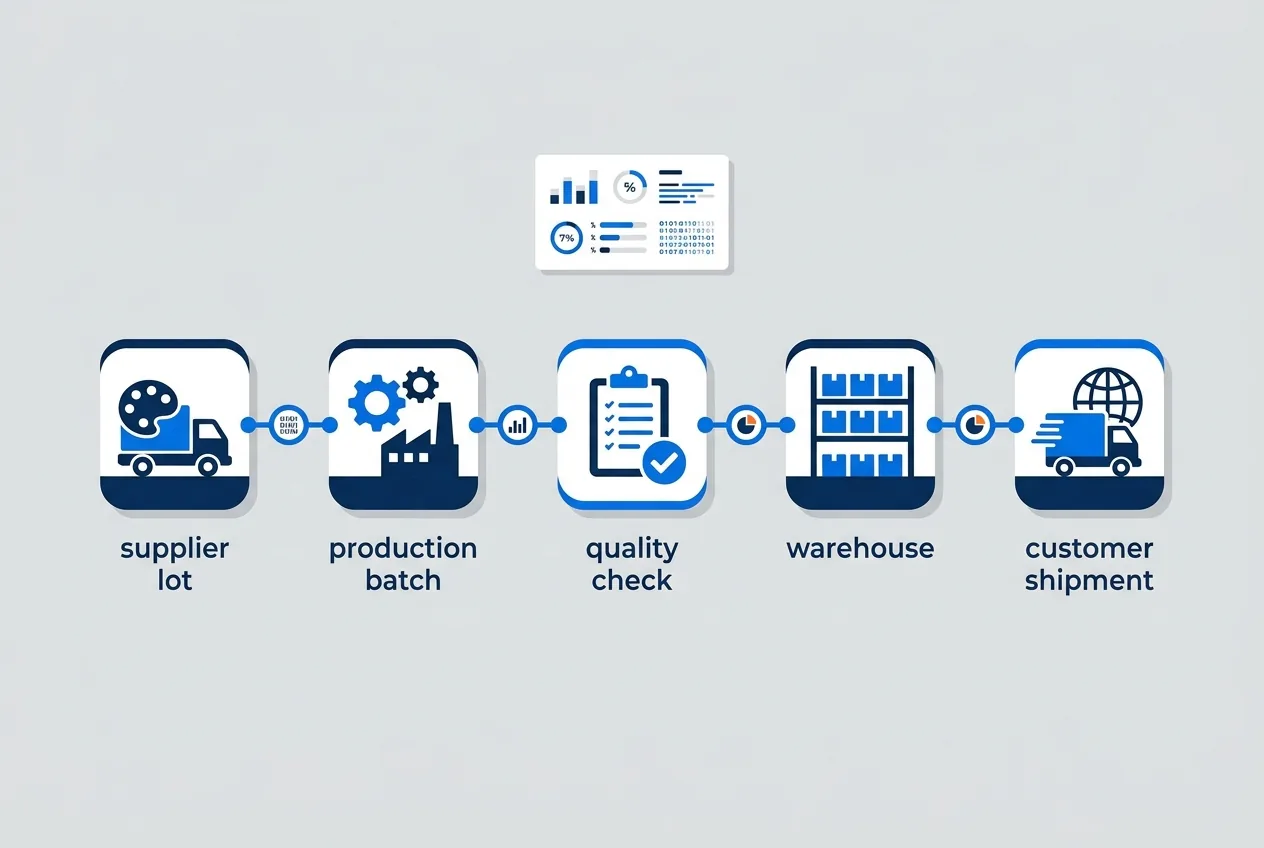
Forward and backward lot genealogy built into inventory and quality workflows.
Plant-floor integration
Connections between production lines, scales, quality systems and the warehouse.
Four pressures that shape sauces & dressing operations
These are the recurring problems we see when formulation, batching, filling and distribution operations run on disconnected systems.
Flavour consistency at scale
Ingredient variation and manual adjustments cause batch-to-batch differences that customers notice.
Ingredient price volatility
Oils, tomatoes, dairy and spices move in price. Standard costs go stale, hiding margin erosion.
Allergen and label control
Many SKUs share lines and ingredients, so allergen declarations and labels need tight control.
SKU and pack proliferation
Retail, foodservice and private-label formats multiply planning and inventory complexity.
Capabilities built for formulation, batching, filling and distribution operations
Pick the area closest to your priority. Each can be delivered on its own or as part of a wider programme.
Keep formulas, nutrition and cost in one governed record.
- Recipe versioning and approval workflows
- Nutrition and allergen calculation
- Ingredient substitution rules with cost impact
- Standard and actual cost comparison by batch
Make batches repeatable and traceable.
- Batch orders with scanning and weighing control
- Viscosity, pH and Brix checks captured at the line
- Filling and packing yield tracking
- Changeover and cleaning checklists
Support customer and regulatory demands.
- Allergen matrices and label verification
- Lot genealogy from ingredient to pallet
- Specification and certificate management
- Non-conformance and corrective action workflows
Serve retail and foodservice from one plan.
- Channel-specific price lists and rebates
- Demand planning by SKU and customer
- Available-to-promise stock visibility
- Margin by SKU, customer and channel
Two scenarios where connected data changes the day-to-day
These are illustrative scenarios that describe the business objective. They are not customer case studies.
Keeping standard cost honest as ingredients move
Purchase prices flow into batch cost automatically. Finance sees variance by ingredient and recipe, and sales sees the margin impact before quotes go out.
Business objective: reprice and reformulate on current cost.
Verifying allergen labels at the line
Label and recipe allergen data are compared at packing. A mismatch blocks release and records the check.
Business objective: avoid label errors and recalls.
How we approach delivery and evidence outcomes
We do not publish unverified customer figures on industry pages. This is how we make outcomes measurable in an engagement.
Baseline first
We agree the starting measures with you before design, such as batch yield, ingredient cost variance and order fill rate.
Delivery in stages
Releases are phased by site and process, so each stage is tested against real operations before the next.
Measured against your targets
Dashboards report the baseline measures from go-live, so benefit is judged on your data.
Examples of Routeget engagements can be discussed in a discovery call, subject to client approval for each reference.
Why Routeget for sauces & dressing
We bring a delivery approach built around the realities of multi-ingredient recipes, flavour consistency and mixed retail and foodservice channels.
Recipe and ingredient depth
We treat recipes, ingredient substitutions and nutrition data as controlled records, so every batch matches the approved formula and cost.
Integrated, not stitched together
Formulation, production, quality, warehouse and sales share one data model, so operational and financial records reconcile.
Phased, low-disruption rollout
We plan releases around seasonal product launches and retail promotion calendars to protect service levels.
Data you can act on
Analytics are designed with your operations team, so measures reflect how your plants actually run.
Related reading from the Routeget team
Perspectives on the supply chain, data and integration topics behind this industry.
Why Automating our Supply Chain is Crucial to your Business Success
Why supply chain automation matters for service levels, cost and resilience.
The Evolving Landscape of Data Modernization Engineering
Trends in data modernization engineering and how they affect enterprise platforms.
AI attracts a new generation while assisting Argentine small producers and winemakers in competing
How AI is helping small producers compete in demanding markets.
Explore adjacent industry practices
Plan your sauces & dressing digital foundation with Routeget
Book a 30-minute discovery to walk through your formulation, batching and filling operations and your priorities with a Routeget industry specialist.
Your details are used only to respond to this enquiry. See our Privacy Policy.
Sauces & Dressing: questions buyers ask us
How do you engage with a sauces & dressing business?
We usually start with a short discovery and a process review of one batching and filling line with its recipe library. From there we propose a phased scope, which can be fixed-scope for defined releases or a time-and-materials team for ongoing improvement.
Can you handle private-label and foodservice formats together?
Yes. We model customer-specific recipes, pack formats and labels, and report cost and margin by label and channel.
How do you manage recipe changes and approvals?
Recipes are versioned with controlled approvals. Production only sees the active version, and changes carry an audit trail.
Who owns the data and the configuration?
You do. The solution runs in your own environment, and configuration, data models and reports are documented and handed over so your team can maintain them.
How do you approach pricing and timelines?
Pricing and timing follow scope, including the number of recipes, pack formats and customer channels. We share an estimate after discovery, with assumptions and exclusions stated, and we confirm timelines only after reviewing your landscape.